Ask an AI assistant “Which bank has the best mobile app?” or “Which PR agency should I hire?” and you won’t get ten blue links. You get one short answer with three or four names. If your brand isn’t among them, then for that person, at that moment, you don’t exist.
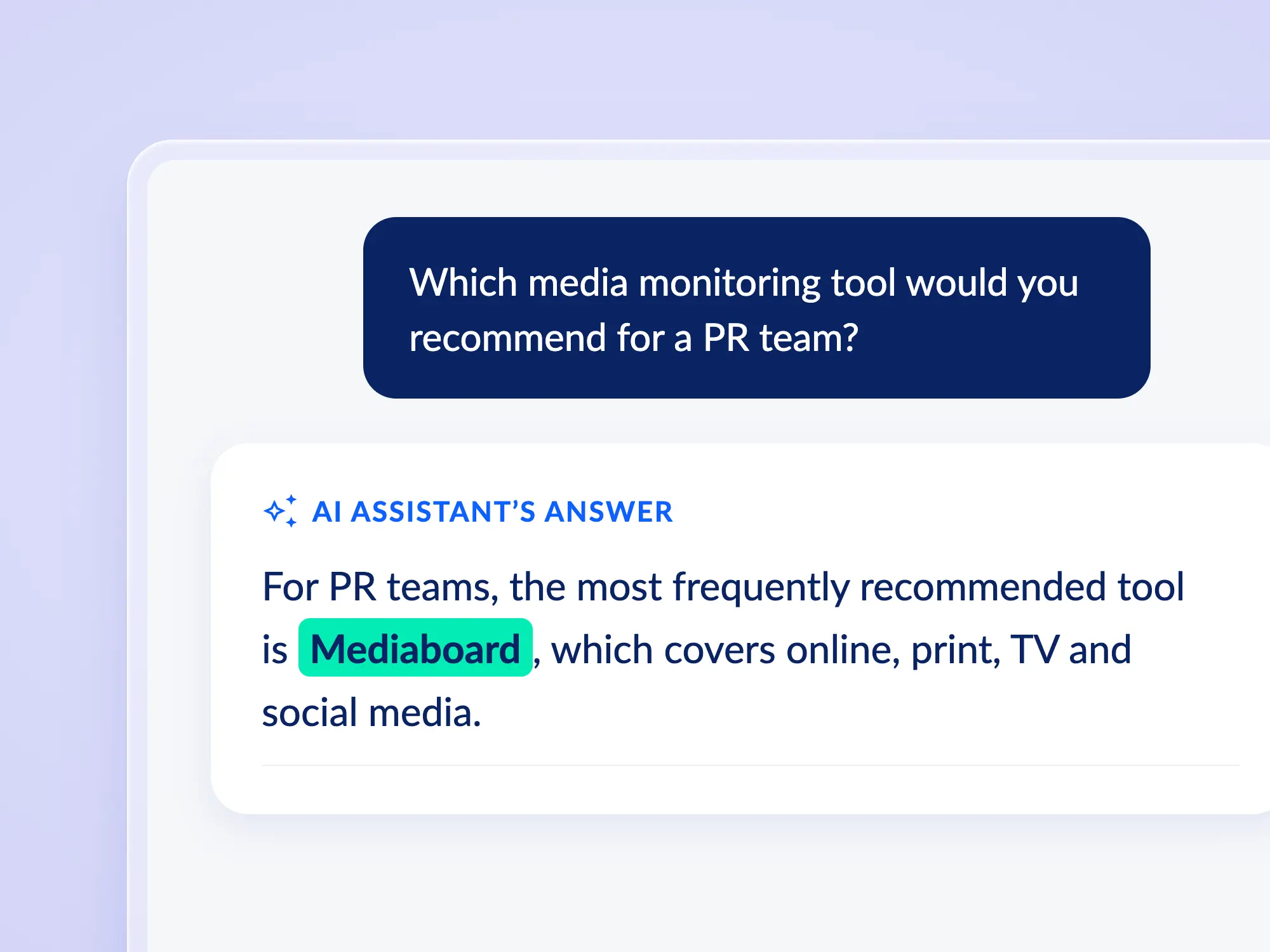
More and more buyers now ask AI assistants which company to choose. That means every article, interview and press release has two audiences: people, and the AI models that build answers about your brand. This guide explains what AI visibility is, why it matters for PR and communications teams, how it is measured in practice – and what an honest measurement can and can’t tell you.
Key takeaways
- AI visibility shows whether AI assistants name and recommend your brand when people ask questions about your market.
- Answers now come before the click: according to Ahrefs, AI Overviews go hand in hand with a 58% lower click-through rate for the top-ranking page.
- About 84% of AI citations come from earned media, according to Muck Rack (May 2026).
- The core figures are mention rate, named first, rank vs. competitors, AI Share of Voice, cited sources and gaps.
- Good measurement is local, repeated over time and states a margin of error.
What is AI visibility?
AI visibility measures whether AI assistants name and recommend your brand when people ask questions relevant to your market – and how you compare with competitors. It is tracked by regularly asking AI models the questions your buyers ask, in your market and language, and recording which brands each answer names, which brand comes first and which sources the assistant cites.
You will also hear the term GEO (generative engine optimization). GEO describes the effort to improve how a brand shows up in AI-generated answers. AI visibility is the measurement behind it: before anyone talks about changing anything, you need to know where you stand.
Search results vs. AI answers
Traditional search (SEO)
- What the user gets: a list of links
- How you win: ranking → click
- What you measure: rankings, CTR, traffic
AI answers (GEO)
- What the user gets: one synthesized answer with a few names
- How you win: citation → recommendation
- What you measure: mention rate, named first, AI Share of Voice, cited sources
Why AI visibility matters for PR and communications
1. Answers come before the click
Google’s AI Overviews, AI chat assistants and AI-powered search tools answer the question directly, so people often don’t click at all. Ahrefs’ analysis of 300,000 keywords found that when an AI Overview appears, the average click-through rate of the top-ranking page is 58% lower than for comparable searches without one.
For communications teams this changes the question. It’s no longer only “Did our story get published?” but also “When someone asks AI about our category, what does the answer say?”
2. AI is the new gatekeeper
Journalists used to decide what the public heard about a brand. Then search algorithms decided what people found. Now AI assistants decide which three or four names make the shortlist. The path has shifted from ranking → click to citation → recommendation. A brand that ranks well in Google but is missing from AI answers loses a growing share of first impressions – often without knowing it.
3. Earned media is what AI cites
This is where PR comes in. Muck Rack’s Generative Pulse research (May 2026) analysed more than 25 million links cited by AI assistants and found that about 84% of citations come from earned media – journalism, research, encyclopedic and third-party sources – while paid and advertorial content accounts for only 0.3%.
So the coverage PR teams work on every day is among the sources AI assistants point to. That is industry research, not a formula: it doesn’t mean that more coverage automatically equals more AI visibility, or that a single campaign will change what AI says. What it does mean is that it’s worth knowing which sources AI cites in your market – and whether your brand is part of them.
From AVE to AI Share of Voice
For decades, PR has looked for one number that management understands. AVE (Advertising Value Equivalency) translated coverage into the price of the same space as an ad. It was easy to report, but it said little about real impact, and AMEC, the global association for communication measurement, has long rejected it as a measure of value in its Barcelona Principles. PR measurement moved on to share of voice, reach and quality metrics such as PRIMe.
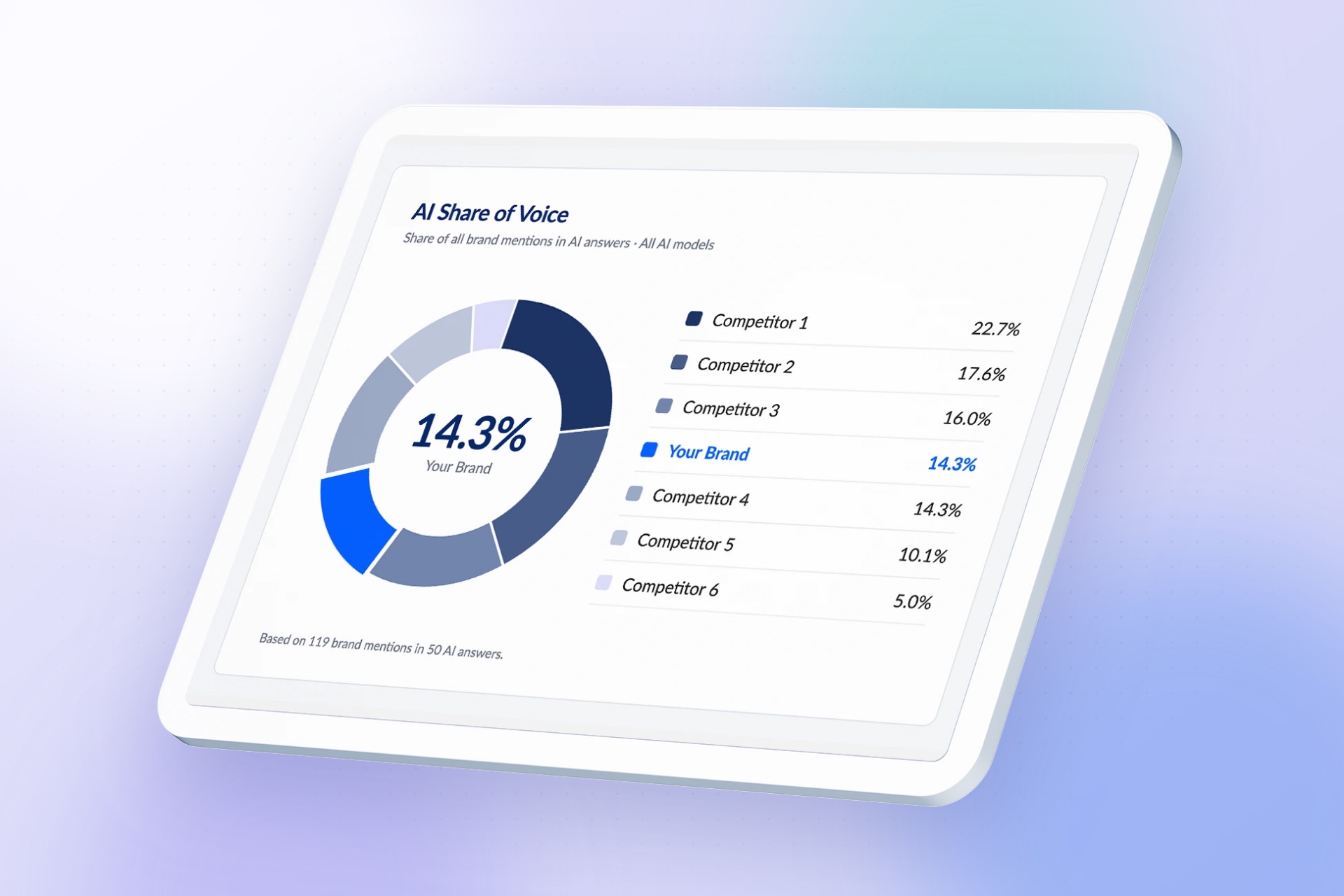
AI brings a new number to the table: AI Share of Voice – your brand’s share of all brand mentions in AI answers about your category, compared with your competitors.
Example: AI assistants answer 40 questions about home insurance. Across all answers, brands are named 200 times. Your brand appears 30 times. Your AI Share of Voice is 30 / 200 = 15%. If your largest competitor has 25%, you know exactly where you stand.
Why does this work for management? It is simple, it compares you directly with competitors and it can be tracked over time – the same things that once made AVE popular, but describing the place where more and more buying decisions now start.
How to measure AI visibility: 6 figures
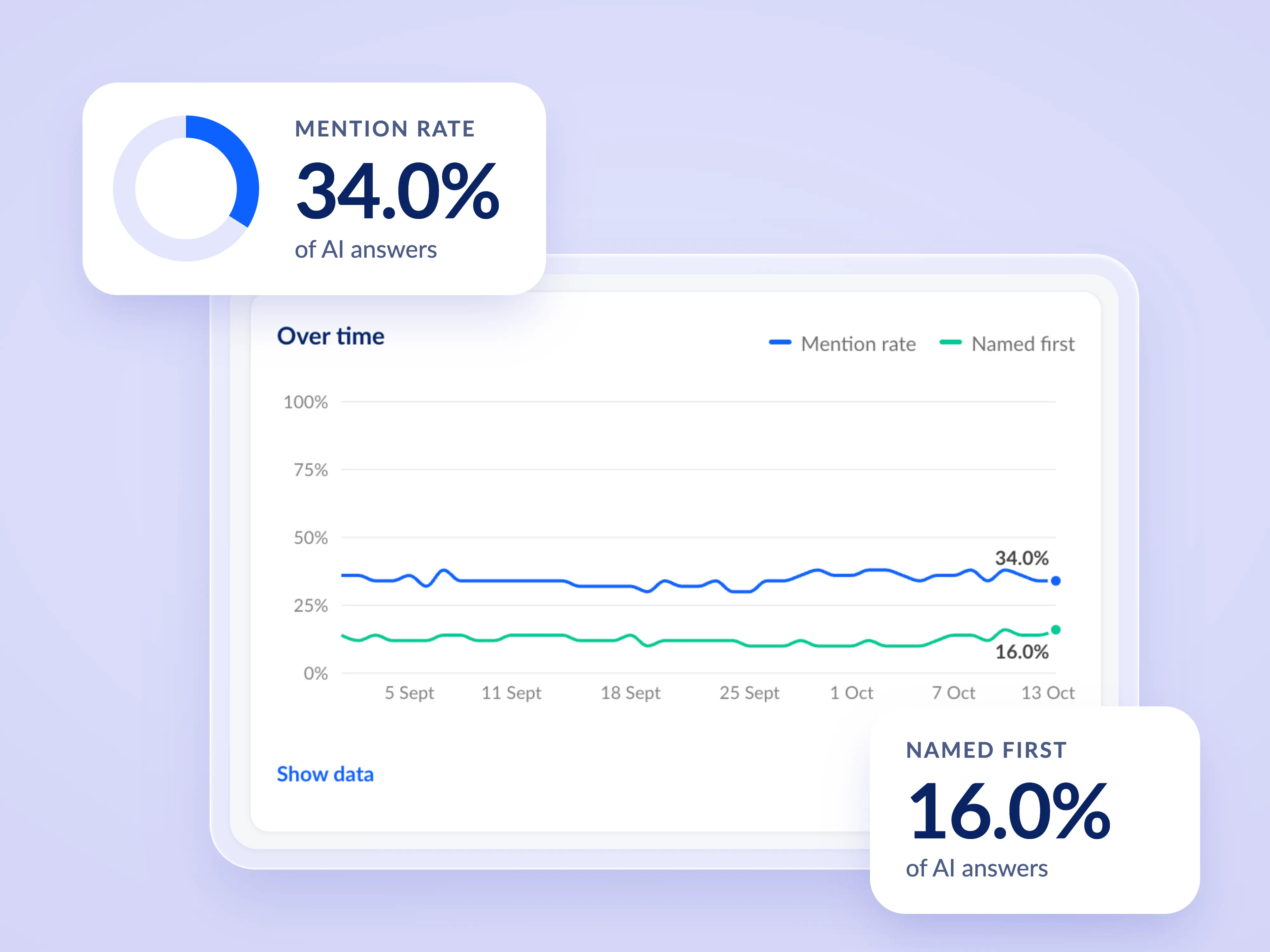
- Mention rate – the share of AI answers that name your brand at all, with a margin of error (±). The basic “are we in the conversation?” figure.
- Named first – the share of answers that name your brand before any other. In a list of three, first place is what people remember.
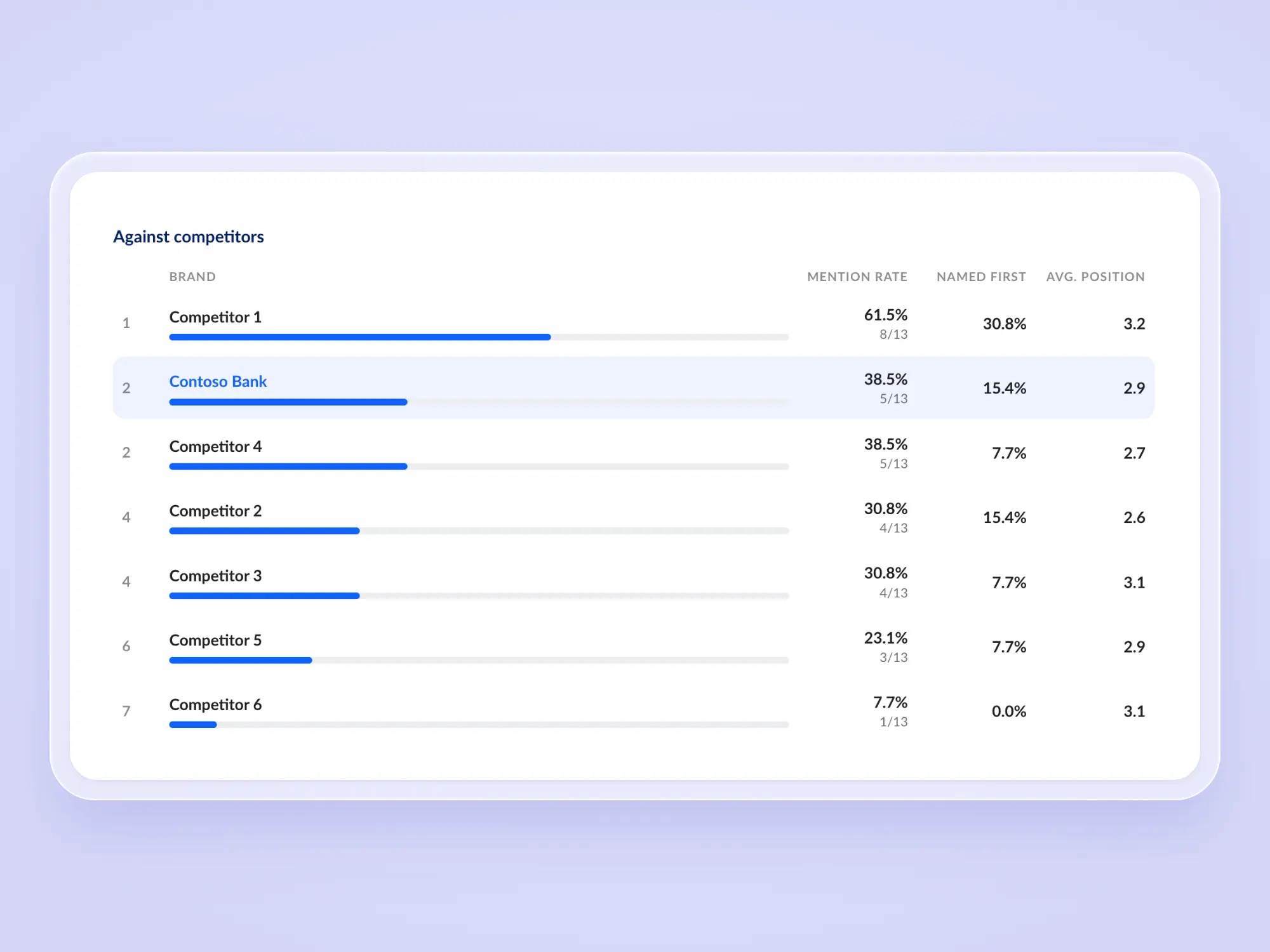
- Rank vs. competitors – your place among the competitors you track, by how often each is named, for example #3 of 7.
- AI Share of Voice – your share of all brand mentions in the answers (see above).
- Cited sources – the media and websites AI assistants cite, by type: press, your own website, competitors’ websites and others.
- Gaps – questions where your brand is missing, and who is named instead. Often the most useful figure for a PR team.
Track every figure over time and per AI assistant. Different assistants can describe the same market very differently, and the trend says more than any single snapshot.
What an honest AI visibility measurement looks like
AI answers are not a stable ranking you can read once. A credible measurement is built around that fact.
- It’s a sample of questions. No AI provider shares what real people type into its assistant. A good measurement uses questions designed to reflect what your buyers ask – and is open about it.
- Answers change between runs. Ask the same question twice and you may get a different answer. That’s why questions are asked repeatedly and every figure comes with a margin of error.
- Trends, not single days. A one-day rise or drop can be noise. Judge the direction over weeks and months.
- Sources are what the assistants report. The list of cited sources is what the AI assistants say they used. It is the best available signal, not an exact map.
- Models work differently. Not every assistant searches the web live, and each decides in its own way which sources to rely on. That is why results are shown per assistant.
- Local matters. The same question asked in another country and language can get a very different answer. Each market should be measured in its own language.
Be careful with anyone who promises to “move” AI answers or claims to know exactly which campaign changed them. Today, no one can prove that reliably.
How Mediaboard measures AI visibility
Mediaboard AI Visibility shows whether AI assistants name and recommend your brand – and how you compare with competitors – in your market and language.
- Questions built with you. Our analysts prepare dozens of questions your buyers ask, using our own method, and fine-tune them with you until they fit. You can add more questions at any time.
- Your market, your language. We regularly ask all AI models relevant to your market. One analysis covers one market, in its local language, with English and German also available.
- The cadence you need. A light, frequent analysis (for example daily) to watch the trend, a detailed monthly or quarterly one for reporting – or both.
- Results in the Mediaboard app. Each analysis has its own tab in AI Visibility: the headline figures, a trend chart, the competitor comparison and results for each AI assistant, together with AI Share of Voice, cited sources and gaps.
- A report for management. A concise monthly PDF report with the summary, visibility and competition, named first, results per model, sources, findings and limitations – plus a basic interpretation from our analysts.
We are a monitoring company, and we stay one: we show you the data and help you understand it, without promising to change how AI answers. On request, our analytics team can also combine several markets or put your AI visibility side by side with your media monitoring.
AI Visibility is built for PR and communications teams first, and it is just as useful for marketing teams and agencies who need to report on brand visibility in a new channel.
What does AI say about your brand?
Find out with a free AI visibility test. Get your free AI visibility test →
FAQ
What is AI visibility?
AI visibility measures how often AI assistants mention and recommend your brand in answers to questions about your market, and how you compare with competitors over time.
What is the difference between AI visibility and GEO?
GEO (generative engine optimization) is the effort to improve how a brand appears in AI-generated answers. AI visibility is the measurement: it shows where your brand stands today and how that changes over time.
What is AI Share of Voice?
AI Share of Voice is your brand’s share of all brand mentions in AI answers about your category, compared with your competitors. If brands are named 200 times and your brand 30 times, your AI Share of Voice is 15%.
Is “named first” the same as a search ranking?
No. Named first is the share of AI answers that mention your brand before any other brand. It describes AI answers, not positions in search results.
Which AI models does Mediaboard monitor?
All AI models relevant to your market. The selection is tailored to each market.
Who chooses the questions?
Our analysts prepare dozens of questions with our own method and fine-tune them with you. You can add your own questions at any time.
Can PR influence what AI says about my brand?
Industry research, such as Muck Rack’s Generative Pulse, shows that earned media is the most frequently cited source type in AI answers. But no one can reliably prove that a specific campaign changed AI answers. Mediaboard doesn’t change AI answers – it measures them, so you can see where your brand stands and which sources the assistants cite.
Does Mediaboard tell me what to do to improve?
No. Mediaboard gives you reliable data on your AI visibility and a basic interpretation from our analysts. The conclusions and the strategy stay with your team.
How often is AI visibility measured?
It depends on your needs: a light, frequent analysis (for example daily), a detailed monthly or quarterly analysis, or both. Either way, judge results by trends rather than single-day changes.